
News of all that's transpired on and off the football field

The government's stance in the face of uncertain prospects for the private sector has been that public sector investment will drive the system.

Prof Ananth Narayan, well known financial expert who works as a faculty member at the SP Jain Institute of Management and Research and the RBI's nominee director on the board of Yes Bank, expects a double-digit contraction in India's GDP this fiscal year. In the first of a two-part interview to Shobha Warrier/Rediff.com, Prof Narayan, below, says, "Giving liquidity and loan to cover the cash flow problem is not sufficient because you are essentially increasing the debt of many of these companies. And they might not be able to bear the burden."

The apex court also observed that the compensation is not the remedy for the suicides.
From banking reform to financial reconstruction, the bullet train, Navi Mumbai airport, choosing a new medium fighter aircraft to be made in India... time is running out for Modi. How could a leader as energetic and astute as Modi have left it for so late, asks Shekhar Gupta.

Economists have long argued that they shouldn't be expected to predict crises, such as the one that almost sank the global economy five years ago.
The progress we made in recent past should not detract us from making further structural reforms: Rajan
Most brokerages have maintained their Sensex and Nifty targets as they believe there is little room for further re-rating in the backdrop of weak earnings.
Conversion of outstandings into equity even partially should be a strict no-no says Chatered Accountant S Murlidharan

In an offline chat, mind/life coach, NLP trainer and Mental Health Guru Anu Krishna encourages Rediff.com readers to talk about their problems and offers solutions.

Nifty 50 firms' net profit estimated to grow by a modest 3.1% in Q2, reports Krishna Kant.

The repo rate could be reduced by 50 bps in the current year.

Levying buyback tax at a flat rate of 20 per cent (plus applicable surcharge and cess), irrespective of the period for which shares are held will be a dampener for equity shareholders who take inherent risks while investing, says Hitesh D Gajaria, partner and head of tax, KPMG in India.

Prime Minister Narendra Modi's landslide election in 2014 raised hopes he would draw a line under India's socialist past, cut welfare and reduce the government's role in business.

The government must set up a Bank Investment Company to shrink its role in PSBs, if we are serious about tackling the two persistent issues - lax corporate governance practices and discretionary decision-making, says Shyamal Majumdar.
At least five state-run banks on central bank's radar for lax credit appraisal

Bad loans continue to originate mainly from state-owned banks, where the top management's responsibility is not linked to career prospects nor has legal consequences, says Debashis Basu.

We should work in unison to boost growth: FM
Shortly after the Union Budget was announced, political leaders from across the spectrum reacted to it. Here's what some of our leaders said.

'This prime minister thinks he knows everything.' 'He has to consult, he has to talk and he has to mobilise the best people, but having seen him function, I have no expectations from him.'

Farmer suicides have nearly doubled in the drought-hit Marathwada region of Maharashtra.
In a statement, the CBDT, which is the apex policy making body for direct tax policies, said it has never asked IRS Association or these officers to prepare such a report and no permission was sought by them before making the report public. 'It is unequivocally stated that CBDT never asked IRS Association or these officers to prepare such a report.

Bankruptcy Code will consolidate existing laws related to liquidation and sick industries

'We all wanted a strong Centre with a decisive mandate from the people, to allow them to take bold decisions.'
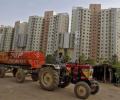
While Mumbai is home to India's costliest real estate, Thane is the fastest growing housing market in the country

The Congress has raised several questions on the Rafale deal, accusing the government of compromising with national interests.

HDFC twins, Axis Bank, ICICI Bank and SBI from the financial space gained between 1-2.7%.

Asked whether the IAF can play a role in smashing terrorist training camps across the Line of Control in Jammu and Kashmir, he did not rule out such a possibility.

'India-China economic ties are likely to take a hit in the wake of the new situation, but that also provides India with a new opportunity to strengthen its manufacturing base,' points out Dr Rajaram Panda.

The Congress chief said if his party is elected to power, its government would spend 6 per cent of the GDP on education.

The author finds out if India's love affair with Old Monk has ended
The Reserve Bank of India (RBI) has offered some leeway to banks for early detection and resolution of bad loans. Under the new regime kicking off from April 1, lenders can finance 50 per cent of the outstanding loan value, RBI said in Framework for Revitalising Distressed Assets in the Economy, released on Thursday.

The Union Budget announcement of a minimum support price (MSP) that will be 50 per cent more than the cost of production has started a debate on the calculation of cost. Ramesh Chand, member, NITI Aayog, speaks to Sanjeeb Mukherjee on this and related issues.

Chinese govt has itself to blame for first trying to slow down the property market and later propping it up.

Modi govt has a unique style of working, say experts.

Other bidders include Abu Dhabi Investment Authority.
Delhi CM Arvind Kejriwal said the govt will extend a loan of Rs 551 crore to two civic bodies; and alleged a situation was being created through the ongoing strike to prepare grounds for imposition of central rule.
In spite of Budget's rural focus, the government has consistently stumbled in agriculture, says Shreekant Sambrani.
Chief ministers of states like Andhra Pradesh, Kerala and Karnataka were among those who raised the issue of loan waver scheme for farmers.

'Gloom is nowhere in sight, with healthy foreign exchange reserves, a strong rupee, healthy tax collections, corruption and crony capitalism under check,' argues Gopal Krishna Agrawal.
